

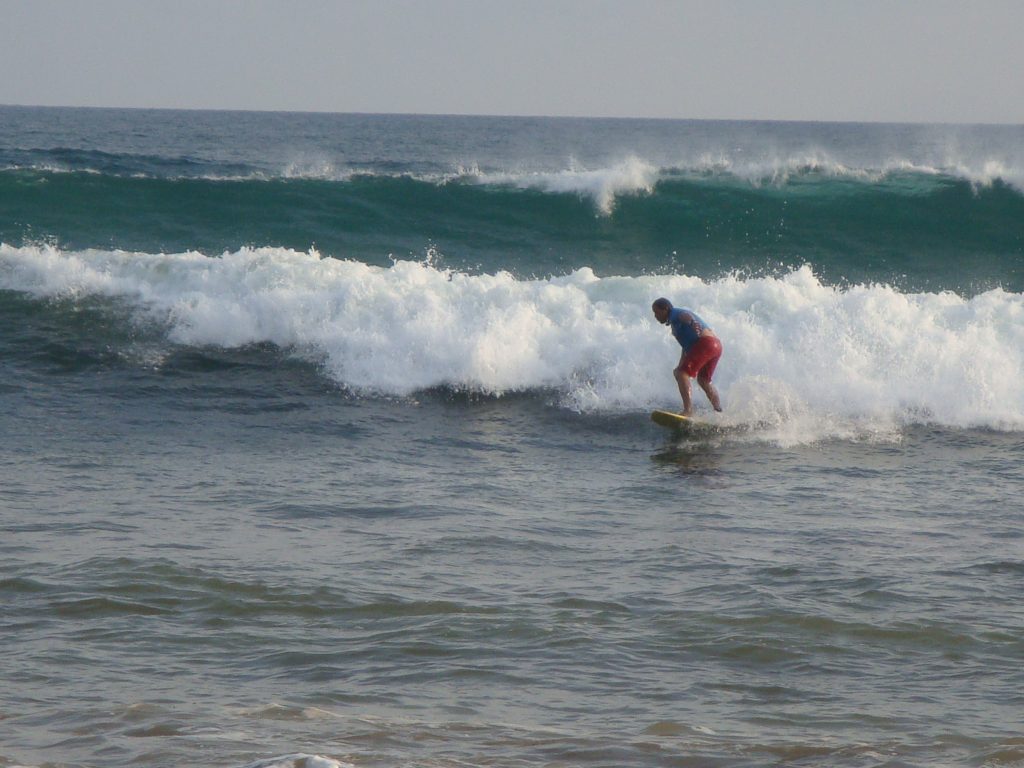
What Surfing Has Taught Me About Fitness, Focus, Physics, and Life
Most people look at surfing and see a beach, a board, and some tanned person gliding around.
What they don’t see is one of the most demanding physical and mental activities I’ve ever put myself through.
I’ve surfed in Costa Rica, Nicaragua, Peru, California, Mexico, British Columbia, Ireland, and the Caribbean. From the endless left-hand point break at Chicama to the cold Atlantic swells battering the Irish coast, the kelp forests of BC, and the warm Pacific breaks of Mexico. Different oceans. Different breaks. Same lessons.
Surfing has become one of the greatest teachers in my life. And I don’t say that lightly.
The workout nobody talks about
People assume surfing is mostly about standing on the board. Standing is actually the easy part.
The majority of a surf session is paddling. Thousands of strokes. Sprint efforts. Duck-diving waves. Holding your breath. Fighting currents. Unlike the gym, the ocean decides the intensity — not you.
Some days it gives you a gentle warm-up. Other days it’s a marathon, an interval session, and a swimming competition rolled into one. You don’t get to choose.
The result is cardiovascular endurance, shoulder strength, core stability, balance, flexibility, and recovery capacity — all built simultaneously. No machine does that.
Concentration is everything
You cannot think about emails in the ocean.
You cannot think about meetings. You cannot replay yesterday’s mistakes. The ocean simply won’t allow it.
When you’re sitting outside waiting for a set, every bit of attention goes to the water. Reading the horizon. Watching swell lines. Studying the current. Positioning yourself for what’s coming.
For an entrepreneur or professional who spends too much time in their own head, that’s worth more than a therapist’s couch.
Surfing is moving meditation. Go figure.
The physics matters more than you’d think
One thing that genuinely surprised me early on — how much science is actually involved.
Experienced surfers don’t just look at wave height. They study swell period. A six-foot swell at a 16-second period carries vastly more energy than the same height at eight seconds. Longer period, more organized energy, more powerful wave.
You start thinking about bathymetry, tidal movement, wind direction, wave refraction. At Chicama, the wave wraps around a point break to create some of the longest rides on the planet. In Ireland, Atlantic storm systems travel thousands of kilometres before reaching shore. In California, local winds and coastal geography can flip a break in a matter of hours.
Over time you stop thinking like an athlete and start thinking like a physicist. The ocean is one giant physics classroom — and it doesn’t charge tuition.
Resilience, the hard way
Surfing teaches resilience faster than almost anything I know.
You wipe out. You get held underwater. You miss the wave. You paddle twenty minutes only to watch someone else catch the best one of the day.
Then you paddle back out and do it again.
The ocean doesn’t care about your resume, your job title, or your track record. Every session starts at zero. That humility is healthy — even if it’s uncomfortable.
Over time, what develops is patience, emotional control, risk assessment, and the ability to stay calm when things go sideways. These are exactly the same skills required in business and leadership. The ocean just has a more efficient way of drilling them in.
How snowboarding improved my surfing
Living in the Sea to Sky corridor has an unexpected perk — the mountains and the ocean are in constant conversation.
Years of snowboarding have done more for my surfing than I ever anticipated. The edge-to-edge weight transfer, reading terrain at speed, absorbing the unexpected — it all translates directly to a surfboard. Balance isn’t just about not falling. It’s about feeling subtle shifts before they happen and responding instinctively. Snowboarding sharpens exactly that.
If you surf and haven’t spent time on a board in the mountains, you’re leaving something on the table.
The view from the water
There’s something else surfing gives you that’s harder to articulate.
When you’re in the ocean, you’re not watching nature from the shore. You’re inside it. A seal surfaces ten feet away and goes about its business. Dolphins run the same wave you just caught. You watch a storm front build on the horizon and feel the swell shift beneath you before you can see why.
It’s the difference between being in the audience and being on the stage. The environment stops being scenery and starts being something you’re part of. That shift in perspective — from observer to participant — changes how you move through the world.
Travel as the real education
Surfing has taken me to places I’d never have visited otherwise.
I’ve watched fishermen launch boats before sunrise in Nicaragua. Shared waves with locals in the Caribbean. Explored rugged coastline in Ireland. Chased swells through Los Angeles and San Diego.
What I’ve found is that while the waves are different, surfers everywhere speak the same language. Respect for the ocean. Willingness to help newcomers. A shared understanding that the best moments in life are usually the simplest.
No classroom taught me that.
But mostly — it’s just fun
For all the talk about fitness, physics, focus, and mental toughness, the real reason surfers keep coming back is much simpler.
It’s fun.
The feeling of dropping into a clean wave never gets old. The early morning sunrises. The friendships made in parking lots and lineups. The travel. The stories. The moments when everything clicks and for a few seconds you’re moving in harmony with the ocean’s energy.
Those moments are hard to explain to someone who hasn’t felt them.
Surfing has given me great adventures, good friendships, and lessons that extend well beyond the water. It’s taught me to stay fit, stay focused, respect nature, embrace uncertainty, and keep learning.
And if I’m lucky, I’ll still be paddling out at ninety.
Some things are simply too good to stop doing.
— Patrick Smyth, Whistler